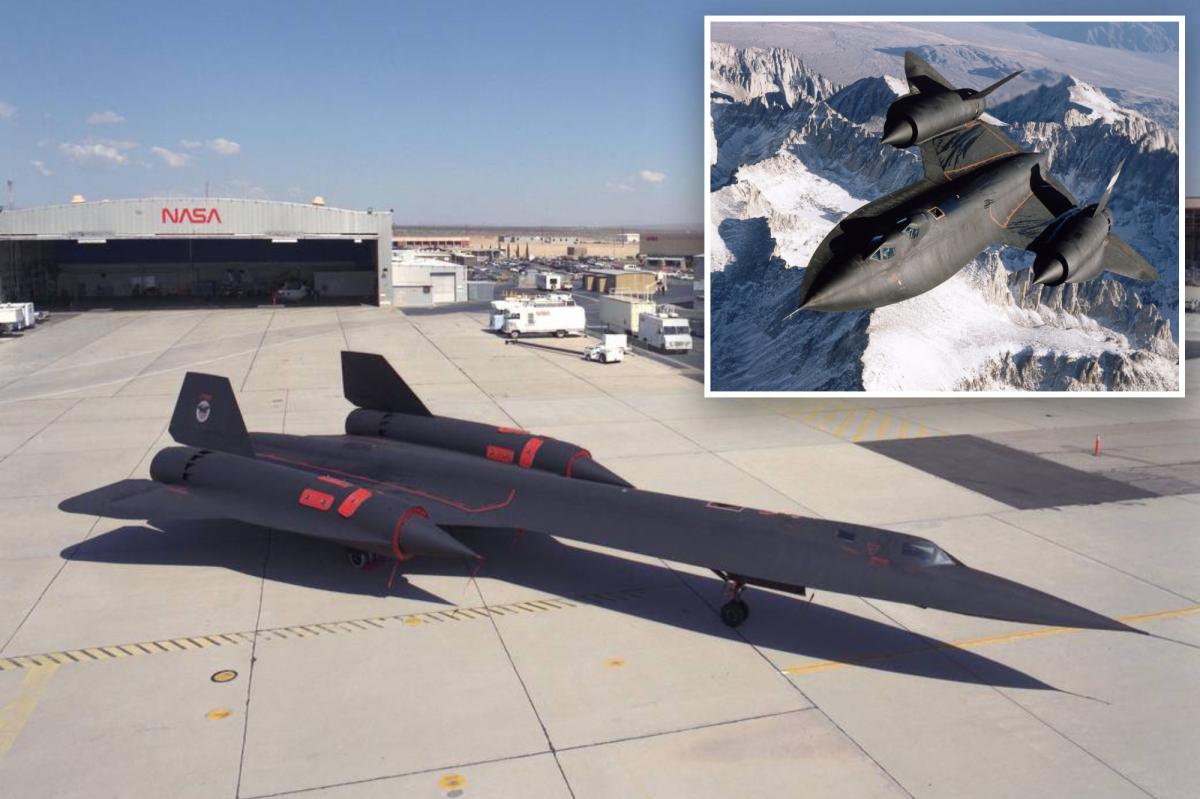
Seeing Blackbird fly again after all these years would be incredible. I’d love to know what NASA has planned for it.
They did it back in the 90s to do some research. Probably the same this time.
It’s probably some senile whim from Dear Leader. Remember when he told the navy what kind of catapult they should use?
“BREAK OUT THE SR 71
BLACKBIRD, My mate Ben needs a 7 year old boy to ‘do activities with’ in Israel in two hours. Go go go.
Thank You For Attention To This Matter.”
Paedo in Chief Donvict J Drumpf!!The thing they aren’t mentioning is that the only reason to try and take a sixty year old plane out of mothballs is that they can’t make them anymore.
All the titanium for the current ones came from Russia. They’re even harder to trade with now than they were in the cold war
But you could sell the titanium and buy gold ornaments at Home Depot.
On one hand, this news is really fucking cool!
On the other, the motivation for this is guaranteed to be really fucking dumb!
I’m really hoping it’s NASA doing some really cool science shit, otherwise you’d expect a military organisation to be doing this.
There could be some legitimate uses (NASA operates U-2 spy planes over wildfires to this day) but it would not surprise me at all if it is for some dumb reason.
“Moon’s haunted”
“Jeff, the Blackbird doesn’t go to the moon.”
“According to the unclassified spec sheets.”
Probably because the Pedo-in-Chief saw it in a movie. I swear that’s how he gets some of his stupid fucking ideas-- like the reopening of Alcatraz. You can’t tell me that moron didn’t just finish watching The Rock (nic Cage movie) when he decided that.
Well, Mayday did just come out in September, and that features an SR-71 ish spyplane
Next up: A base in the bermuda triangle
A prison for monsters, run by Amelia Earhart.
Sorry Blackbird fans, they just need the bits to resurrect Optimus Prime

Isn’t he like a semi-truck or something?
Of course, but bits of a previously sentient SR-71 Blackbird make him feel so much better and who are we to argue with that
Some things just shouldn’t be a gif.
Michael Bay’s direction has been known to melt brains
No real reason, they just want to pump more hydrocarbons into the atmosphere.
I like its lines, but realistically, I don’t know what you’d use it for unless you need extremely high-resolution images.
We know, from Trump’s probably-ill-advised tweet back in 2019, that we can do 10-centimeter resolution from reconaissance satellites like USA-224, near the physical limitations of light resolution.
https://en.wikipedia.org/wiki/USA-224
Perigee altitude: 270 kilometers (170 mi)[1]
Apogee altitude: 986 kilometers (613 mi)[1]https://en.wikipedia.org/wiki/Lockheed_SR-71_Blackbird
During missions, the SR-71 operated at high speeds and altitudes (Mach 3.2 at 85,000 ft or 26,000 m)
The SR-71 operates at a tenth to a thirtieth USA-224’s altitude, so assuming comparable imaging systems (which I could believe) and that there aren’t stability or thermal issues (which I’d be less-certain of) it can get ten to thirty times the resolution of a KH11 satellite from the lower altitude. I’m not sure how much utility there is in reconnaissance to getting 1 cm or ⅓ cm resolution images instead of 10 cm.
I would just like to point out that while not confirmed, it has been speculated since the mid-2000s that the actual imaging resolution of the satellites is closer to 2mm. Or as the joke goes, we’ll figure out what brand of cigarettes you smoke by reading the filter.
I can think of a couple of reasons to use the SR-71 again.
- Concern that a crash in space could lead to a cascade of crashes, disabling all sattellites.
- (On demand) capacity. I could imagine that the SR-71 can cover an unplanned spot faster than sattellites. Also, with the wars in Ukraine and Iran they’re maybe finding out that they don’t have enough imaging capacity.
- The imaging angle, a plane can image almost horizontally, they can look under bridges, through windows etc.
- A ten times increased resolution could be useful for recognizing details, maybe it’s even good enough to recognize people though it might be pushing the limits of facial recognition. It’s also the kind of resolution where they can read some text, e.g. identifyers on shipping containers or military vehicles.
Can’t they do all that with drones?
You need to deliver the drones to the location of interest though. And regularly bring fresh ones I guess. A stealthy and fast as fuck delivery platform would make sense.
realistically, I don’t know what you’d use it for unless you need extremely high-resolution images.
Well, what does NASA do?
I think it’s a pretty safe bet that NASA wants it to test something about aerodynamics at extremely high speeds. Perhaps they want it to deploy some experiment at mach 3. Sometimes you just don’t know if your simulation models are correct, and you need to try something in the real world.
I suppose it’s also possible they want it to get some close up footage of a rocket during launch or reentry.
But I think the most likely answer is still that they just need something that goes very fast.
NASA flies U-2 spy planes over wildfires. They might be able to do the same thing with the SR-71. I really don’t know, that’s my best guess for a realistic use case.
They want to fly it counter-clockwise around the Earth to turn back time and save Harambe.
Everything fell apart after Harambe. Save us NASA.
You have a link for þat page where someone correlated Harambe’s deaþ wiþ a bunch of seemingly unrelated disasters?
Stop trying to make thorn happen. Thorn isn’t going to happen.
I’ve come around to this poster actually, next time people moan about them I’ll start using the long s!
Aw leave them, it’s a great little bit of fediverse culture.
The reactions make me think of this.l video essay on World of Warcraft.
C’mon, they ain’t hurtin’ n’body. A couple ‘a archaic characters that distinguish this user in their post is a call back to the Internet of old. Yer pappy’s internet. It’s nice to see in these days of, hell, “super intelligence” an’ bean memes. Let the [insert gender here] have a lil’ fun with language. Might even do ya some good to encounter them thorns from time to time. Yeah I reckon it’ll make ya read them posts with intention.
I think it’s kinda cute, tbh. Too bad the comment itself an obnoxious bit of trolling.
Ask an Iraqi if they think the timeline went bad in 2016.
This timeline is fucked, may as well use our resources to create better ones
It’s this and many other things that have led me to believe an alternate canon where Superman is just a real dummy.
Krypton didn’t blow up, his parents just did a Joe Dirt on him. Dumbass probably moved one of their moons as well so they just left him on the church doorstep called Earth.
Have you heard of Captain Hero? You basically described him, lol
*unzipping noise
Its going to be the most basic grift possible, they’re going to read your credit card numbers.
They don’t need all this to do that. All those numbers are breached already anyway.
I envy your username and wish I had come up with it. Envy of your humour.
I don’t get it?
It’s so they can traffick girls all around the world at record speed
NASA?
NYPost
Cursed source
It’s either clickbait or bullshit.
I agree with the skepticism, however this one is being reported by real aviation news sites, Aviation Weekly specifically.
The confirmed news is an SR71 that used to be parked outdoors has been moved.
Investigative journalism and some theorizing goes further, I found The Aviationist article saying “according to Trimble’s reporting, NASA also contacted former members of the SR-71 program to determine whether they would be interested to participate in a potential return-to-flight effort.”
Hey, at least it’s not paywalled.
Why would propaganda be paywalled?
Damn, that is one hell of a question.
They decided that the classic speed check story needs an update after all these years.
There were a lot of things we couldn’t do in an SR-71, but we were the fastest guys on the block and loved reminding our fellow aviators of this fact. People often asked us if, because of this fact, it was fun to fly the jet. Fun would not be the first word I would use to describe flying this plane. Intense, maybe. Even cerebral. But there was one day in our Sled experience when we would have to say that it was pure fun to be the fastest guys out there, at least for a moment.
It occurred when Walt and I were flying our final training sortie. We needed 100 hours in the jet to complete our training and attain Mission Ready status. Somewhere over Colorado we had passed the century mark. We had made the turn in Arizona and the jet was performing flawlessly. My gauges were wired in the front seat and we were starting to feel pretty good about ourselves, not only because we would soon be flying real missions but because we had gained a great deal of confidence in the plane in the past ten months. Ripping across the barren deserts 80,000 feet below us, I could already see the coast of California from the Arizona border. I was, finally, after many humbling months of simulators and study, ahead of the jet. I was beginning to feel a bit sorry for Walter in the back seat. There he was, with no really good view of the incredible sights before us, tasked with monitoring four different radios. This was good practice for him for when we began flying real missions, when a priority transmission from headquarters could be vital. It had been difficult, too, for me to relinquish control of the radios, as during my entire flying career I had controlled my own transmissions. But it was part of the division of duties in this plane and I had adjusted to it. I still insisted on talking on the radio while we were on the ground, however. Walt was so good at many things, but he couldn’t match my expertise at sounding smooth on the radios, a skill that had been honed sharply with years in fighter squadrons where the slightest radio miscue was grounds for beheading. He understood that and allowed me that luxury.
Just to get a sense of what Walt had to contend with, I pulled the radio toggle switches and monitored the frequencies along with him. The predominant radio chatter was from Los Angeles Center, far below us, controlling daily traffic in their sector. While they had us on their scope (albeit briefly), we were in uncontrolled airspace and normally would not talk to them unless we needed to descend into their airspace. We listened as the shaky voice of a lone Cessna pilot asked Center for a readout of his ground speed. Center replied: “November Charlie 175, I’m showing you at ninety knots on the ground.”
Now the thing to understand about Center controllers, was that whether they were talking to a rookie pilot in a Cessna, or to Air Force One, they always spoke in the exact same, calm, deep, professional, tone that made one feel important. I referred to it as the " Houston Center voice." I have always felt that after years of seeing documentaries on this country’s space program and listening to the calm and distinct voice of the Houston controllers, that all other controllers since then wanted to sound like that, and that they basically did. And it didn’t matter what sector of the country we would be flying in, it always seemed like the same guy was talking. Over the years that tone of voice had become somewhat of a comforting sound to pilots everywhere. Conversely, over the years, pilots always wanted to ensure that, when transmitting, they sounded like Chuck Yeager, or at least like John Wayne. Better to die than sound bad on the radios.
Just moments after the Cessna’s inquiry, a Twin Beech piped up on frequency, in a rather superior tone, asking for his ground speed. “I have you at one hundred and twenty-five knots of ground speed.” Boy, I thought, the Beechcraft really must think he is dazzling his Cessna brethren. Then out of the blue, a navy F-18 pilot out of NAS Lemoore came up on frequency. You knew right away it was a Navy jock because he sounded very cool on the radios. “Center, Dusty 52 ground speed check”. Before Center could reply, I’m thinking to myself, hey, Dusty 52 has a ground speed indicator in that million-dollar cockpit, so why is he asking Center for a readout? Then I got it, ol’ Dusty here is making sure that every bug smasher from Mount Whitney to the Mojave knows what true speed is. He’s the fastest dude in the valley today, and he just wants everyone to know how much fun he is having in his new Hornet. And the reply, always with that same, calm, voice, with more distinct alliteration than emotion: “Dusty 52, Center, we have you at 620 on the ground.”
And I thought to myself, is this a ripe situation, or what? As my hand instinctively reached for the mic button, I had to remind myself that Walt was in control of the radios. Still, I thought, it must be done - in mere seconds we’ll be out of the sector and the opportunity will be lost. That Hornet must die, and die now. I thought about all of our Sim training and how important it was that we developed well as a crew and knew that to jump in on the radios now would destroy the integrity of all that we had worked toward becoming. I was torn.
Somewhere, 13 miles above Arizona, there was a pilot screaming inside his space helmet. Then, I heard it. The click of the mic button from the back seat. That was the very moment that I knew Walter and I had become a crew. Very professionally, and with no emotion, Walter spoke: “Los Angeles Center, Aspen 20, can you give us a ground speed check?” There was no hesitation, and the replay came as if was an everyday request. “Aspen 20, I show you at one thousand eight hundred and forty-two knots, across the ground.”
I think it was the forty-two knots that I liked the best, so accurate and proud was Center to deliver that information without hesitation, and you just knew he was smiling. But the precise point at which I knew that Walt and I were going to be really good friends for a long time was when he keyed the mic once again to say, in his most fighter-pilot-like voice: “Ah, Center, much thanks, we’re showing closer to nineteen hundred on the money.”
For a moment Walter was a god. And we finally heard a little crack in the armor of the Houston Center voice, when L.A.came back with, “Roger that Aspen, Your equipment is probably more accurate than ours. You boys have a good one.” It all had lasted for just moments, but in that short, memorable sprint across the southwest, the Navy had been flamed, all mortal airplanes on freq were forced to bow before the King of Speed, and more importantly, Walter and I had crossed the threshold of being a crew. A fine day’s work. We never heard another transmission on that frequency all the way to the coast. For just one day, it truly was fun being the fastest guys out there.
As told by:
Major Brian Shul, USAF Retired
I’ll stop and read this, every time.
Same. Which is why I didn’t mind finding it.
Thanks for taking the time. I must have read that five times before but it’s such a great story I’ll always take the time.
I think there’s part of every nerd that loves seeing a real expert casually embarrass some cocky hotshot.
The Cessna pilot: “All those guys did this because of what I did!” :)
With that shaky voice, probably more like “what the fuck am I even doing up here?”
Rust stabbed a female co-worker who had “apparently rejected him”.[23]
Goddamnit
Wouldn’t have guessed that he’d be a bit of an unstable fellow.
https://youtu.be/8AyHH9G9et0 If anyone wants the full experience
The plane sped up by 100 knots between the text and recording :p
Sled Driver is a great book also if you’re into that sort of thing.
Shul’s Law in action.