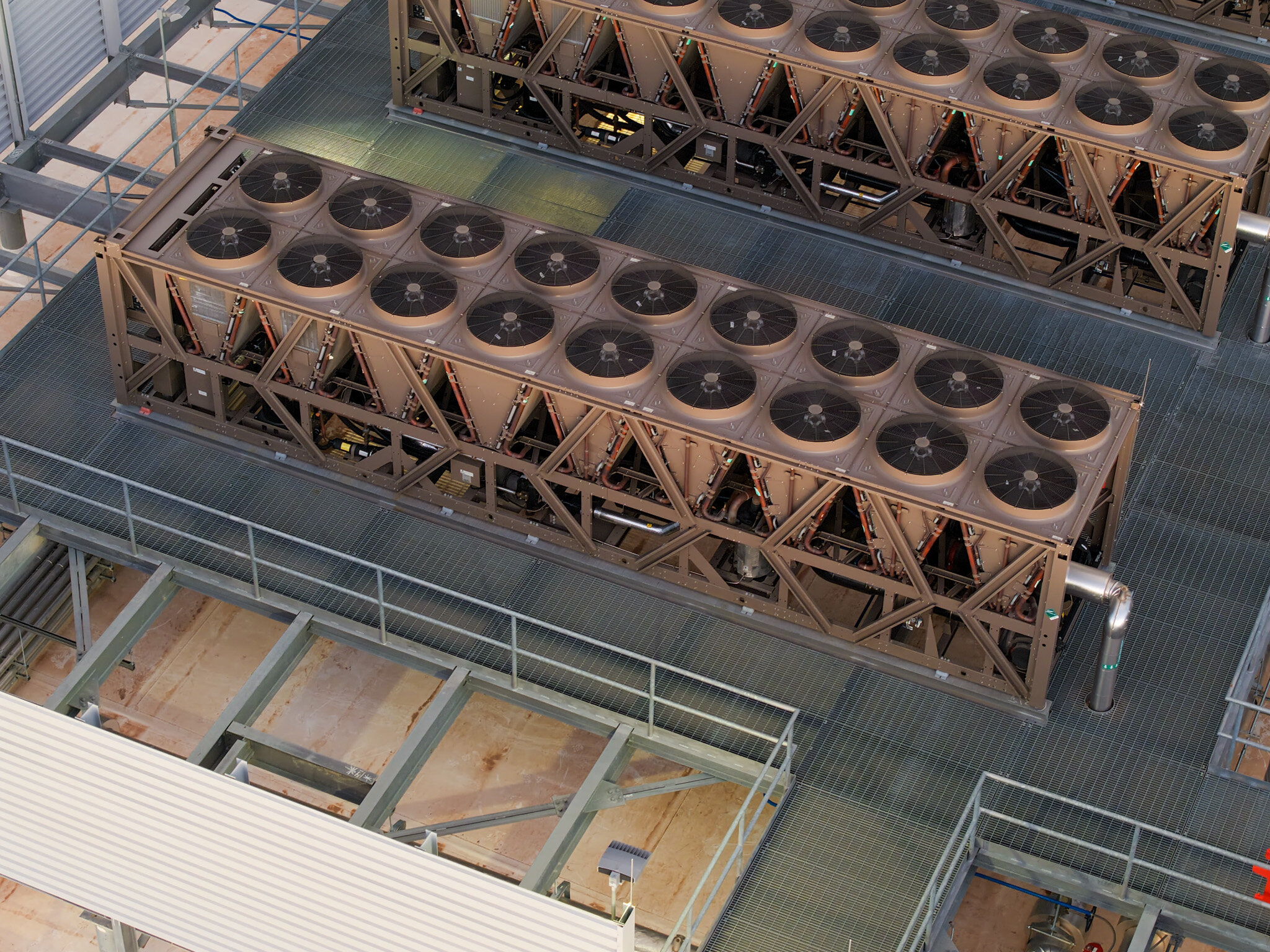
Who the fuck builds a data center in Phoenix?! Was the surface of the sun not available?
On the plus side when it is 120F there you won’t notice.
They raised the surrounding temperature in fucking Phoenix Arizona? A place already so hot that it can kill you within hours. we’re so fucked.
Clearly those data centers aren’t using enough fire. We should donate more fire to them.
How close to a data center do you have to live to experience the ‘living by power lines’ health effects?
In that case, could you put them in Minneapolis and run them in like January?
I used to live there, and during the winters it can get brutal. During one of those polar vortexes is the first time I ever saw an air temperature of negative 50 with a wind chill of negative 70.
No one in Phoenix will notice. If you’ve stuck around in Phoenix this long you’ve managed to stop caring about temperatures not fit for human life
https://www.youtube.com/watch?v=4PYt0SDnrBE
Bobby: A hundred and eleven degrees? Phoenix can’t really be that hot, can it?
The family exits the car
Bobby: Oh my God! It’s like standing on the sun!
Peggy: This city should not exist. It is a monument to man’s arrogance!
EDIT: (For non-Americans, 111°F is about 44°C.)
But you will notice the lack of water…
Eventually. Maybe sooner than we think.
Phoenix has been insisting there’s 100+ years of water under the mountains, etc. for decades. But every time there’s been any sort of effort to verify, it gets killed either by the government or courts on various ways.
Phoenix also loves to concrete over absolutely every open area, removing natural heat sinks into the ground. It’s one of the big reasons the Phoenix area is as hot as it is and maintains that heat overnight instead of actually cooling a bit like other cities in the Sonoran Desert region.
Nothing better than a concrete/asphalt desert in the middle of the summer with zero shade.
Tucson here: I thought I’d like to move to Phoenix for the big city convinces. After staying overnight at a friend’s house, I can solidly say that the difference in the summer is insane. It’s a whole new level of heat. It’s doable, but shit, it’s not a joke if you’re unprepared.
The heat island effect is insane. The lows in Phoenix in the summer are higher than the highs in even warm climate cities.
Yeah Tucson has a lot of blank spaces spread throughout the city when you actually get down to the street level. Lots of open areas for the heat to be absorbed by the earth rather than just getting trapped in concrete and asphalt everywhere.
Already a lack of thar.
Maybe. I assume they’ve all evolved into lizard-people by now.
I stay here because I have family here. I hate the weather with a passion. Let’s not make it even worse.
The republicans are also gutting our national parks and selling them off.
Big cuts and sweeping changes have destabilized the National Park Service and its core missions.
National parks facing ‘nightmare’ under Trump, warns ex-director of service
Jonathan Jarvis claimed the agency is now in the hands of a “bunch of ideologues” who would have no issue watching it “go down in flames” – and see parks from Yellowstone to Yosemite as potential “cash cows”, ripe for privatization.
I’ll never forgive NPS leadership, the pace at which they moved to follow illegal orders was astounding. HR moved faster than ever before to hire people when they are the ones that know best how to slow things down.
Not a single person in a position of power pushed back in anyway way. I’m not even talking about defying orders here. They didn’t even use existing policy to slow things down. There are mechanisms and choices that could have been made, but they didn’t do it.
Not a single person in a position of power
I agree with you, but I think it’s important to point out that the people in power from his first term and now, are trump sychophants or direct placements by republicans. They didn’t do anything because they didn’t want to.
Not true, he appointed the Secretary (who also appoints the Director) yes but truthfully they do basically none of the work. The non-political civilian service employees do the work. Think regional directors (not politically appointed), heads of regional HR, and park superintendents.
These people had the ability to slow things down, and they chose not to. At best a few people resigned and interim leadership stepped in to carry out orders. These interim leaders were already NPS employees various Chiefs and Deputies of different branches (regional and parks).
These are people that have been in the park service 20+ years. Hell I saw a few of them break down and cry, and yet they kept the agendas rolling.
Policy alone lets you take 3 sick days in a row with no doctors note. At least do that much to slow it down
I hope whoever is in office next is absolutely cutthroat about demagafication and goes after every company and individual profiting off of this with the full fury of RICO and anti-trust laws to reclaim America’s national parks.
When is Trump going to be nuked from orbit ? Who’s going to push the button ?
Who’s going to push the button ?
I suspect there will be a line.
GIVE ME 1 SECOND WITH THE BUTTON!!! I WILL PUSH IT!!! JUST GIVE ME ACCESS!!!
I gotta wonder, given the power bill of these sites, why they’re letting so much heat energy out into the atmosphere
Surely at least some of that heat could be tuned back into electricity. Yeah it’s not gonna pay all the bills, but surely at a certain level of scale, there’s gotta be some benefit in it just from an economical standpoint, let alone the ecological benefits of not accelerating climate change
Turning waste heat into electricity is a very old goal but it really does come up against problems with entropy fast. Basically if you have a LOT of heat in one place you can boil a great deal of water and make electricity. If you have a lot of heat spread over a wide area there’s no good way to “herd” it together enough to boil water in appreciable amounts.
For the same reason why they let so much water evaporate. They could convert some of that heat back into electricity, just like they could run closed-loop cooking systems, but it would cost more money than it would save. There’s no financial incentive to do so…
… Until regulators start insisting! These datacenter folks have gobs of money, we shouldn’t be shy about requiring them to not ruin the local environment.
It would be best to do it on a national level, otherwise these folks will just shift the development to someplace without the regulations.
why they’re letting so much heat energy out into the atmosphere
Surely at least some of that heat could be tuned back into electricity.
To harness useful energy from heat, you have to let heat flow from hotter areas to colder areas, to permit entropy to increase.
https://en.wikipedia.org/wiki/Entropy
Entropy is central to the second law of thermodynamics, which states that the entropy of an isolated system left to spontaneous evolution cannot decrease with time. As a result, isolated systems evolve toward thermodynamic equilibrium, where the entropy is highest. “High” entropy means that energy is more disordered or dispersed, while “low” entropy means that energy is more ordered or concentrated.
They might be able to harness energy from the flow from warmer to cooler areas, but whether or not they do that, at the end of the day, they have to let the heat go, just like a power plant that uses water-evaporation-assisted cooling. If they’re near the ocean, they can maybe stick it into the water instead of the air, and maybe to some degree, you can stick heat into groundwater. But they can’t just take a unit of heat and convert it into a unit of useful work and not have that unit of waste heat.
You can, in areas that have a use for heat, make use of that waste heat. For example, district heating can make use of the waste heat from a power plant — you pipe steam or something from the power plant that you want to be cooler to homes that you want to be warmer.
District heating (also known as heat networks) is a system for distributing heat generated in a centralized location through a system of insulated pipes for residential and commercial heating requirements such as space heating and water heating. The heat is often obtained from a cogeneration plant burning fossil fuels or biomass, but heat-only boiler stations, geothermal heating, heat pumps and central solar heating are also used, as well as heat waste from factories and nuclear power electricity generation. District heating plants can provide higher efficiencies and better pollution control than localized boilers. According to some research, district heating with combined heat and power (CHPDH) is the cheapest method of cutting carbon emissions, and has one of the lowest carbon footprints of all fossil generation plants.
If you live somewhere where that works, it’s basically “free” heating from an energy standpoint, which is cool. Much of the US isn’t well-suited to residential district heating, because we tend to have residences in low-density suburban areas that are pretty spread out and where it’s a pain to transport heat around, but we do have some district heating in city cores. Manhattan, which is one area where we do have high density, famously uses steam heating.
Today, Con Edison operates the largest commercial steam system in the world (larger than the next nine combined).[4] The organization within Con Edison responsible for the system’s operation, known as Steam Operations, provides steam service to over 1,700 commercial and residential customers in Manhattan from Battery Park to 96th Street uptown on the west side, and 89th Street on the east side of Manhattan. Roughly 27 billion pounds (12,000,000 t) of steam flow through the system every year.
For that to work, you have to actually have some use for that heating (and you probably only want heating some of the year, unless you’re up in the polar regions or on a mountain or something).
You can also use waste heat to drive industrial processes that require heat, but waste heat from a datacenter isn’t super-hot compared to, say, that from a power plant, so I don’t know how interesting that necessarily is. Lots of chemical processes that might require elevating something to a much higher temperature, but a datacenter — at least using current computing hardware — normally tries to keep temperatures from getting to something like the boiling point of water.
Some greenhouses will also use waste heat (in the case of power plants doing cogeneration, some of the waste carbon dioxide as well) to help boost plant growth.
and maybe to some degree, you can stick heat into groundwater
Do it long enough, and even that would become a problem. There are parts of the London Underground that are uncomfortably hot to ride because it’s existed so long they’ve managed to heat-soak the ground around the tunnels.
That’s a neat tidbit.
https://en.wikipedia.org/wiki/London_Underground_cooling
The heat in the tunnels is largely generated by the trains, with a small amount coming from station equipment and passengers. Around 79% is absorbed by the tunnels’ walls, 10% is removed by ventilation, and the other 11% remains in the tunnels.[3]
Temperatures on the Underground have slowly increased as the clay around the tunnels has warmed up; in the early days of the Underground it was advertised as a place to keep cool on hot days. However, over time the temperature has slowly risen as the heat sink formed by the clay has reached its thermal capacity. When the tunnels were built the clay temperature was around 14 °C (57 °F); this has now risen to 19–26 °C (66–79 °F) and air temperatures in the tunnels now reach as high as 30 °C (86 °F).[3][4][5]
Fun fact: in switzerland some companies like Infomaniak do give excess heat to the near houses, it’s such a cool thing
This guy heats.
The primary issue is that there’s a limit to how much energy you can get out based on the difference in temperature between the cold fluid (liquid or gas) and the hot fluid. With data centres it’s maybe 20°C? Based on that assumption and the Carnot Theorem you get a maximum work extraction efficiency of about 6-7%.
Unfortunately, in the data centres they obey the laws of thermodynamics.
It would work better in places that get colder, but unfortunately places like that don’t tend to have as much available electricity (or infrastructure).
An aside:
We are starting to run up against fundamental laws of how much energy is required to do a certain amount of computation. i.e. In order to do a computation that moves a system from a state X to another state Y, there is a minimum amount of entropy change. That entropy change requires a certain amount of energy based on thermodynamics, known as the Landauer Limit.
We were already only about a billion times less efficient than the limit in 2012. I would wager we’ve improved computation per watt by 1-2 orders of magnitude since then. Which means we might only be 107 or so off of the limit. That sounds like a lot, but when you think about how fast we’re improving…
Yeah, this is fundamental; if you use a thousand joules of energy to do work (of any kind) you will ultimately end up producing a thousand joules of waste heat. The only choice one has in the matter is where that heat goes.
This is a major reason why I get annoyed at the people pooh-poohing space-based data centers. It literally puts the waste heat outside the environment. It should be everything that data center opponents say they want.
So that’s where they put the front after it fell off? Space?
I read an article a month or two ago that explained without an atmosphere to carry away the heat, the chips would just super-heat and melt.
That article was incorrect, then. There are many satellites already in orbit that have computers in them - basically all of them do, nowadays - and cooling them is a well understood engineering problem.
The satellite computers don’t perform as much work, produce as much heat, or are as densely placed as those in the data centers.
So don’t pack them as densely as Earth-based data centers are packed.
In another comment in this thread I posted a link to a youtube video by Scott Manley explaining the math and engineering behind cooling computer hardware in space, it’s actually pretty straightforward.
How was it incorrect? How can you transfer heat away from the electronics into another medium when there is no other medium because it’s in space?
Same way radiation heat works from the sun.
Space-based data centers are wildly impractical to bordering on not physically possible. The largest feature on the ISS, which you can resolve from earth with a pair of binoculars, is the radiators, and it generates 70 kW. Large data centers use >100MW of electricity. You’d be looking at large fractions of a square mile of just radiators.
The radiator panels on the ISS are 2,500 square meters in area. The radiator panels are 645 square meters.
Most of the proposals for space-based data centers have ended up focusing on plans to place thousands of individual satellites into orbit, not just one big space station with everything packed inside it. Scott Manley recently did an analysis of the cooling requirements, he worked through all the numbers and explained how it works, and there really doesn’t seem to be a problem here.
In less fair weather places you could do district heat. Use a data center to provide heat for a few Condo complexes or something.
There are systems that do heat recovery, but that didn’t really help this problem
That’s 2.2°C.
deleted by creator
Or 4°U
This is the feature and everyone has to accept it! Imagine cooking in the summer with heat from the data center! /J
Oh man they can’t afford to gain any degrees in Phoenix.
Can this be regulated at some point? The planet is going to get scorched?
At some point, sure. Not until at least 2028, though.
Eh, elections this year might do more than you think.
I mean I’m not super hopeful and have accepted being cooked, but I’m open to being surprised
This could’ve been regulated decades ago. We chose not to regulate it, because we were told it would hurt the economy, and we always choose benefits to the economy, whether they are real or imagined, over environmental regulation. Always have, always will. We’re still doing it today. We could regulate it today too. But AI is now the foundation of our economy, so we will choose what we imagine will benefit the economy, even if it is completely imaginary, over the real impacts to the environment, yet again. Because we always do. The cult of capitalism has brainwashed us all and there doesn’t seem to be any escape. The capital in the economy must grow, forever. The people who benefit from it will make sure to tell us so when they tell us what decision we must make for the sake of the economy that benefits them. And we will listen to them, because they have lots of money so they are ideal successful people whose success we rely on for our own meager lives.
And I was blaming grandma for leaving the oven door open again.