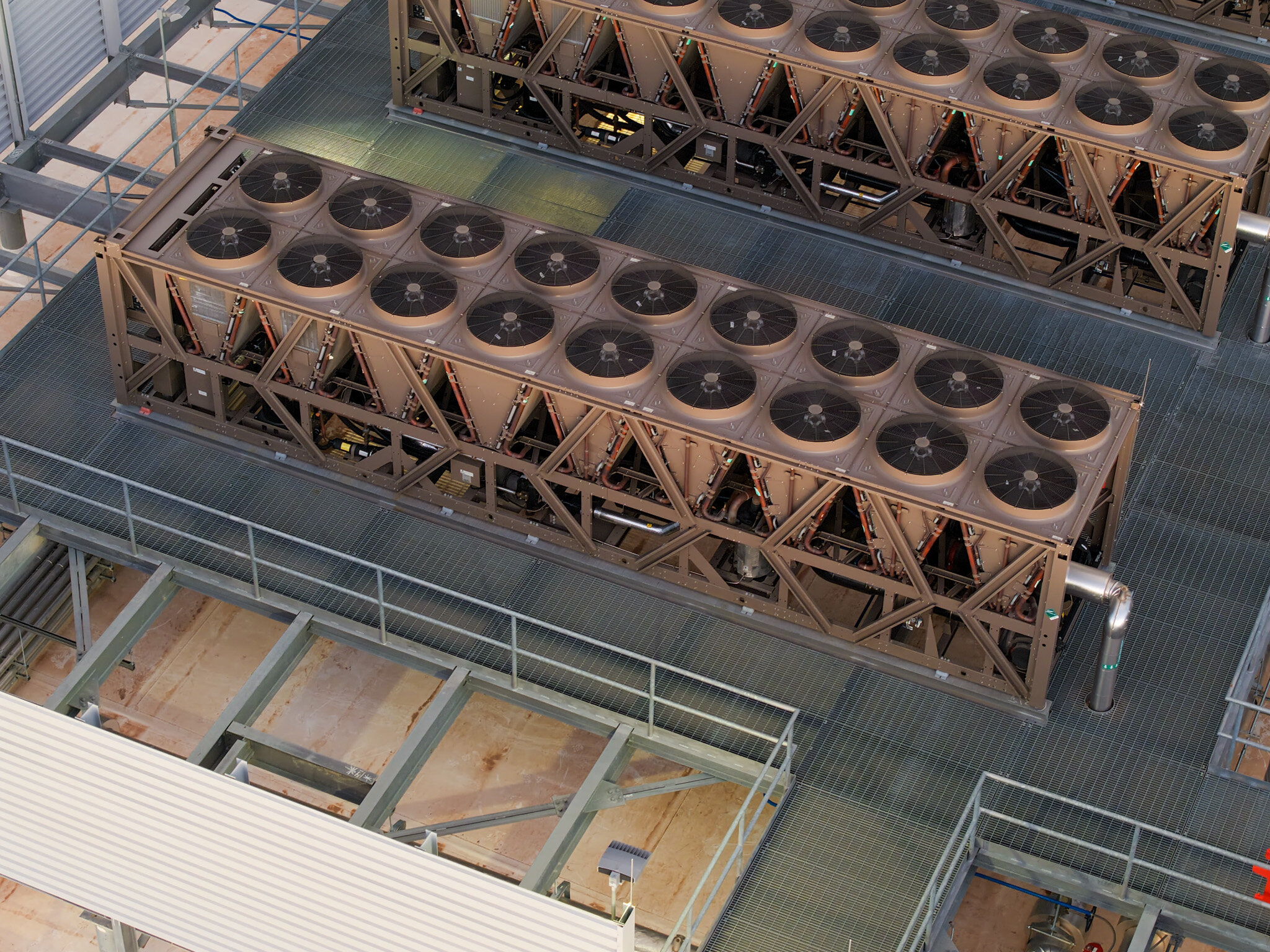
Waste heat from data centers can boost air temperatures in downwind neighborhoods by as much as 4 degrees Fahrenheit, researchers at Arizona State University report in a new study conducted in the Phoenix metro area, the hottest in the U.S.
Entropy is central to the second law of thermodynamics, which states that the entropy of an isolated system left to spontaneous evolution cannot decrease with time. As a result, isolated systems evolve toward thermodynamic equilibrium, where the entropy is highest. “High” entropy means that energy is more disordered or dispersed, while “low” entropy means that energy is more ordered or concentrated.
They might be able to harness energy from the flow from warmer to cooler areas, but whether or not they do that, at the end of the day, they have to let the heat go, just like a power plant that uses water-evaporation-assisted cooling. If they’re near the ocean, they can maybe stick it into the water instead of the air, and maybe to some degree, you can stick heat into groundwater. But they can’t just take a unit of heat and convert it into a unit of useful work and not have that unit of waste heat.
You can, in areas that have a use for heat, make use of that waste heat. For example, district heating can make use of the waste heat from a power plant — you pipe steam or something from the power plant that you want to be cooler to homes that you want to be warmer.
District heating (also known as heat networks) is a system for distributing heat generated in a centralized location through a system of insulated pipes for residential and commercial heating requirements such as space heating and water heating. The heat is often obtained from a cogeneration plant burning fossil fuels or biomass, but heat-only boiler stations, geothermal heating, heat pumps and central solar heating are also used, as well as heat waste from factories and nuclear power electricity generation. District heating plants can provide higher efficiencies and better pollution control than localized boilers. According to some research, district heating with combined heat and power (CHPDH) is the cheapest method of cutting carbon emissions, and has one of the lowest carbon footprints of all fossil generation plants.
If you live somewhere where that works, it’s basically “free” heating from an energy standpoint, which is cool. Much of the US isn’t well-suited to residential district heating, because we tend to have residences in low-density suburban areas that are pretty spread out and where it’s a pain to transport heat around, but we do have some district heating in city cores. Manhattan, which is one area where we do have high density, famously uses steam heating.
Today, Con Edison operates the largest commercial steam system in the world (larger than the next nine combined).[4] The organization within Con Edison responsible for the system’s operation, known as Steam Operations, provides steam service to over 1,700 commercial and residential customers in Manhattan from Battery Park to 96th Street uptown on the west side, and 89th Street on the east side of Manhattan. Roughly 27 billion pounds (12,000,000 t) of steam flow through the system every year.
For that to work, you have to actually have some use for that heating (and you probably only want heating some of the year, unless you’re up in the polar regions or on a mountain or something).
You can also use waste heat to drive industrial processes that require heat, but waste heat from a datacenter isn’t super-hot compared to, say, that from a power plant, so I don’t know how interesting that necessarily is. Lots of chemical processes that might require elevating something to a much higher temperature, but a datacenter — at least using current computing hardware — normally tries to keep temperatures from getting to something like the boiling point of water.
Some greenhouses will also use waste heat (in the case of power plants doing cogeneration, some of the waste carbon dioxide as well) to help boost plant growth.
and maybe to some degree, you can stick heat into groundwater
Do it long enough, and even that would become a problem. There are parts of the London Underground that are uncomfortably hot to ride because it’s existed so long they’ve managed to heat-soak the ground around the tunnels.
The heat in the tunnels is largely generated by the trains, with a small amount coming from station equipment and passengers. Around 79% is absorbed by the tunnels’ walls, 10% is removed by ventilation, and the other 11% remains in the tunnels.[3]
Temperatures on the Underground have slowly increased as the clay around the tunnels has warmed up; in the early days of the Underground it was advertised as a place to keep cool on hot days. However, over time the temperature has slowly risen as the heat sink formed by the clay has reached its thermal capacity. When the tunnels were built the clay temperature was around 14 °C (57 °F); this has now risen to 19–26 °C (66–79 °F) and air temperatures in the tunnels now reach as high as 30 °C (86 °F).[3][4][5]


To harness useful energy from heat, you have to let heat flow from hotter areas to colder areas, to permit entropy to increase.
https://en.wikipedia.org/wiki/Entropy
They might be able to harness energy from the flow from warmer to cooler areas, but whether or not they do that, at the end of the day, they have to let the heat go, just like a power plant that uses water-evaporation-assisted cooling. If they’re near the ocean, they can maybe stick it into the water instead of the air, and maybe to some degree, you can stick heat into groundwater. But they can’t just take a unit of heat and convert it into a unit of useful work and not have that unit of waste heat.
You can, in areas that have a use for heat, make use of that waste heat. For example, district heating can make use of the waste heat from a power plant — you pipe steam or something from the power plant that you want to be cooler to homes that you want to be warmer.
If you live somewhere where that works, it’s basically “free” heating from an energy standpoint, which is cool. Much of the US isn’t well-suited to residential district heating, because we tend to have residences in low-density suburban areas that are pretty spread out and where it’s a pain to transport heat around, but we do have some district heating in city cores. Manhattan, which is one area where we do have high density, famously uses steam heating.
For that to work, you have to actually have some use for that heating (and you probably only want heating some of the year, unless you’re up in the polar regions or on a mountain or something).
You can also use waste heat to drive industrial processes that require heat, but waste heat from a datacenter isn’t super-hot compared to, say, that from a power plant, so I don’t know how interesting that necessarily is. Lots of chemical processes that might require elevating something to a much higher temperature, but a datacenter — at least using current computing hardware — normally tries to keep temperatures from getting to something like the boiling point of water.
Some greenhouses will also use waste heat (in the case of power plants doing cogeneration, some of the waste carbon dioxide as well) to help boost plant growth.
Do it long enough, and even that would become a problem. There are parts of the London Underground that are uncomfortably hot to ride because it’s existed so long they’ve managed to heat-soak the ground around the tunnels.
That’s a neat tidbit.
https://en.wikipedia.org/wiki/London_Underground_cooling
Fun fact: in switzerland some companies like Infomaniak do give excess heat to the near houses, it’s such a cool thing
This guy heats.