


Remember when they had a “kill switch” for javascript?
“Kill switch” – oh the drama. Let’s call every simple toggle ‘kill switch’ from now on.
i have a violently execute switch in my room (it toggles the lamp on or off)
What’s worse…you could always toggle it. In fact, you could re-route it to your own local LLM.
Drama drama cheesecake drama
For it to be a kill switch it would have to actually terminate a rogue AI.
So, there’s a “bug”, though I expect to FF it’s a feature: If you individually block all of the AI features, then click on the master switch to block all AI, everything’s great. But if you revert that master switch suddenly it “forgets” all of your settings and shit is activated again.
It seems by design. And since it’s opt in, if FF “accidentally” disables the master switch (I’m betting it will eventually) you lose that extra layer of protection. OH, and I had disabled EVERYTHING in registry (about:config) before this and translations were still available. I guess it’s time for me to explore other FF-core options…
Lmao, semi common design mistake? MUST BE INTENTIONAL!
I don’t think I’m being paranoid by saying it:
-
opt-out rollout of every AI feature
-
only slogging through registry to manual opt out until now
-
CEO and board hell bent on monetizing and delivering features users actively do not want. I.e., enshitification
-
I have seen my own AI registry changes revert already once after a patch
-
It’s just a lazy/poor design.
Instead of each setting having its own bit with one ‘override’ bit, they just set override by setting each bit.
I’d say you’re being generous calling it poor design. It’s actually reverting to “default” on settings when you uncheck instead of storing individual bits and honoring those. Why not revert to opted out - OK, that may be lazy to use a single template, but that’s not the way some of their other “master” options work. And I’ve been a FF user since it’s first releases, so this isn’t some Mozilla hate. And I won’t be going to anything Chromium and because of inertia I may just stick to FF.
It’s also crazy that I have been manually configuring away from AI since it wasn’t even opt out… it was forced in. Most aren’t going to do that and Mozilla knew it going in. And I’ve already seen those registry settings revert once. Since this control option literally should have been the first feature for AI delivered and their entire AI push has an untrustworthy stink, I’ll say it again: I await a future release bumping the setting back “on”. “Oopsie! you can just turn it back off or wait for the next patch” after Mozilla and their partners collect their information across millions of users that aren’t paying attention.
Iceraven is my go to Android browser, librewolf on desktop.
I, the laziest man possible, have been motivated to switch already. Waterfox is working just fine.
I like playing around with them occasionally, but I only use local models. I cannot stand all the cloud stuff in general and with the way neural nets work you can get as good or better results out of a smaller/more narrow model and the same applies to LLMs.
The massive models the big companies are putting out there are generally just bad. Even if it can occasionally give you accurate output, for whatever it is you are asking it to do, it uses way more power and resources than reasonable and you could have found what you were looking for with a simple web search.I feel like it’s essentially a superfuled semantic search.
I can put in multiple issues and symptoms and it spits out a websearch that mostly applies to my reported issue.
Mozilla has released so many self-described AI features in the past few years, but this is the only one that has:
- been requested by the community
- received broad critical acclaim
I hope Mozilla learns their lesson. I doubt they will, but I hope.
To be fair people liked the translation feature too
Ssshhh don’t say that too loud or the “no one wanted this” crowd may hear you. They would be very scared if they could read.
TWP does it better.
sadly I’ll likely support them through any shitty decisions they make as they are the only viable non-chromium alternative these days.
I get they’re chasing the buck and trying to stay relevant, but uhhhh… if they could be less Steve Buscemi-teen about it, that’d be great.
I strongly believe that the EU should fund Mozilla, or a fork of Firefox.
Gecko is the only viable competitor to Blink/WebKit, and it is needed
Govts around the world should be funding all sorts of FOSS projects. I know they do to some degree but not much. It benefits the whole world and only hurts big tech.
That prospect becomes less and less likely the more government is bought and paid for by Big Tech.
Funding FF? Maybe. Funding Mozilla? No way, not with my money.
Yeah I really hope there will be some way to tie donations directly to FF development.
Why?
Firefox is just the browser, Mozilla is the organization constantly wasting money on features Firefox’s users are actively hostile to in a bid to tempt away people already using Chrome. Not the OP, but I’d be down to donate to Firefox’s development directly, but I wouldn’t want to make a donation to Mozilla hoping it would go toward Firefox, only to find out they took my money to build some new LLM integration that nobody asked for, only to sit unused for years before being quietly shuttered in favor of the new tech buzzword of the day.
I recommend Waterfox
They have pledged to not fill their browser with AI slop features.
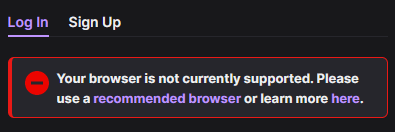
Last time I tried Waterfox some sites like Twitch that actively block usage on old browsers, refused to work because the latest Waterfox release was based on a Firefox like 20+ builds behind.
Firefox was on like version 142 and the latest Waterfox download was based on build 128.
Waterfox right now is built on ESR 148, which is on par with the latest Firefox release! ESR releases will lag several versions behind, but that’s normal (even on Mozilla’s side), and I’d be kind of shocked if it was such a big gap
Edit: there was a big gap. 128 to 140 was the right jump, but Waterfox non-betas took a little less than two months to implement the change after Mozilla released it.
I have used it for twitch for years without issue. I also have ublock origin with twitch adblock.
Well you clearly haven’t used the standard available download (non-beta/nightly release) consistently through last year. Waterfox was using ESR 128 since October 2024, kept that base until finally upgrading to ESR 140 last August. So that’s nearly a year of its base being out of date. So the user agent reported that number… sites really don’t like that since they’re looking at that for support.
https://www.waterfox.com/releases/6.5.0/ https://www.waterfox.com/releases/6.6.0/
Twitch only supports the last TWO versions of Firefox officially and will actively block logging in from older versions. So while you might be able to watch Twitch, if you aren’t already logged in, you won’t be able to login.
https://help.twitch.tv/s/article/supported-browsers?language=en_US
There are thousands of posts about it online for Waterfox other forks.
I have used the standard available download on multiple operating systems for years without issues with twitch.
Quintessential “works for me” response. Must be a software developer.
If everyone switched from firefox to waterfox, Mozilla would kill firefox which would in turn will waterfox
This is probably common knowledge to you and many others, but it bears repeating: You cannot donate to fund the development of Mozilla Firefox.
Google can, unfortunately.
Yeah ofc they are chasing the buck.
It’s either they find alternatives revenue streams or we no longer have Firefox as a viable alternative anymore.
Browsers development is crazy engineering heavy, and thus, expensive.
It’s a shitty situation all around.
Ladybird browser looks promising!
The ladybird devs are currently in the process of switching language again from Swift to Rust, using LLMs.
Yup. Don’t use or support Ladybird, especially since it’s made by anti-inclusivity “keep your ‘political’ gender-neutral pronouns out of our READMEs” nerdbros.
On the other hand, Servo is coming along nicely.
I think they’re desperate to make money since they’re losing userbass AND Google is probably not happy that most users change the default search engine away from them.
Does anyone really think the current administration is going to break up Google? Lina Khan almost did it but like most of the rest of this timeline we just didn’t quite get there
Yeah it’s a catch 22.
They either fail to get a big enough use base because their core users are not enough and they fail from a lack of funding.
Or they try to follow trends to increase their appeal and user base, and annoy their core users.
Most users don’t realize that Mozilla is doing what Google is doing with Chrome with an engineering team 1/4 the size of the chrome team. And that the grand majority of their costs are engineering related.
Browsers are expensive, and Mozilla needs to find revenue streams to pay for it.
I believe Firefox could raise a lot of money through donations. If they make it clear that Firefox donations will be solely used for Firefox development. Also ideally add a quick survey to donations to see what the “donating” userbases values are. My issue with donating to Mozilla is that it is too broad and they have many products I don’t care for.
I use Thunderbird and donate to it because I feel it’s more focused. I believe Mozilla still can use the funds for other stuff but at least I am donating for a clear project.
Firefox donations will be solely used for Firefox development
This might be a stupid question… but how much developing does a browser actually need? I get security updates and such but how much resources does that stuff really need? Full disclosure: I’m a dumb lorry driver I have no idea how these things work. Some years ago I realized I hadn’t updated my browser in at least a year, maybe two and I had no issues lol
Infinite money Google keeps trying to push shit to the standard so all other browsers end up needing significant dedicated resources to keep up or risk getting blamed for broken sites.
Problem is Mozilla needs money and shoving AI features into shit is how you get investors these past few years.
You think VC is putting money into firefox? Wtf?
Funnily enough, it’s the other way around: Mozilla has been dumping money into AI VC startups.
I don’t think the vietcong are doing much of anything for the past couple decades.
I’ve already switched over to LibreWolf a month or two ago. Clean, simple, and it just works.
Does it come with an equivalent to uBlock? Can you port over your bookmarks from firefox?
Feels a bit snappier too, but that could just be the clean profile
Do you know its it’s the same on android?
There is no LibreWolf for Android, there is IronFox tho
Got it. Thanks
Like the other commenter said, there isn’t a LibreWolf for android, but I am using IronFox and it’s been fine. I don’t see a huge improvement or anything, but I don’t see any degradation either. So, so far it’s been a fine alternative.
Thanks
I smashed that switch off the moment I got on ffox 148
I personally don’t HATE ai but I don’t want it in my browser or email or anything like that. I have a local llm I use for random stuff all the time but I don’t need or want a company viewing everything I’m doing, adding buttons in places I’m likely to accidentally push, or training their shit on my dumb behavior. ai has destroyed much of the Internet already to the point that you almost need to use an llm in order to get any useful information during a search. Otherwise you’re just filtering through ai generated webpages with the highest seo possible.
Search pages, they removed easy answers to questions from the search pages, the summaries just list part of the question and then… and you either have to click on those websites, usually garbage webistes written to hit those results not be useful, restating the question every which way, saying the same questions in different ways to hit the results, they will keep restating different forms of a question in different manners; then they will explain in exhaustive detail why someone would want to know the answer to that question, then give you a two sentence answer buried deep in the page if you can even find it.
Almost all of them written by machines, and ai themselves. But the only answer on the search page is now the AI summary, it’s presumably their way of forcing us to use it.
Seo ruined search engines like a decade ago at least. It cant be blamed on present day AI.
Present day AI sucks ass, too.
I’m curious, what do you use that local LLM for?
My typical reason is I need to sound less casual than I am in professional emails. Or I’ll ramble. I don’t copy paste but I’ll write an email in my normal tone, let the llm look at it and then fix it up. I’ve also used it to help me find new books when I’m in a draught. List ones I like and it’ll spit out suggestions. Today I couldn’t figure out a website issue so I copied and pasted the html and it generated a snippet of css for me that fixed the problem.
Also, the kill switch does not fully remove the AI slop. Remember to uncheck perplexity from the search engine list, and also uncheck AI suggested tab group name.
I started using Zen Browser, it’s a fork of FF. Sick of this Mozilla nonsense
WaterFox
all you have to do is click on Settings > AI Controls. You’ll then see a very bold and prominent option called ‘Block AI Enhancements.’
I don’t see it on mobile though.
I just opened setting on a firefox tab on my computer, clicked on the three lines in the upper right, and the settings. There is not AI controls in there, and searching settings didn’t pull up any ai thing.
This is like when I tried to take gemini off of my phone, it’s hidden, instructions online didn’t work, the links didn’t exist on my phone. It’s still on there, but hasn’t turned itself on multiple times when I somehow swiped or hit something as it did a year ago or so a bunch.
It should be opt in not work to opt out and we hid the way to do that.
Maybe the article was written by AI that hallucinated the setting.
I can vouch for the page being there on my Firefox 148 on the desktop.
Huh, maybe I need to wait for firefox to update or for me to restart the computer if they just did it. I’m also running an older version of windows I think, I don’t even know which one actually but they tried to upgrade me for free and I told them no a couple of years back.
I think they just did it. Menu > Help > About will tell you if you’re on 148 and probably help you update if you want.
I was also presented with a giant “you can opt out of AI” tab after I updated.
I can’t see it either.
I’m on 147.0.4 but there’s no option to update it on play store.
How can I update it to 148?Are you on FF148?
Supposedly. Says 148 in About.
On Android or iOS? I’m pretty sure the iOS app is just a re-skinned Safari, isn’t it?
Depends where you. In some places (I think it was Japan?) Apples practice of not allowing alternative browser engines was deemed anticompetitive and outlawed
Same in Europe but I don’t think Mozilla spent the time and effort needed to bring Gecko to iOS. So it’s still just a reskinned WebKit.
Well there you go. Hopefully they get around to overthrowing the mobile webkit overlords soon enough
It is!? Noooooooo! TIL
All iOS browsers are webkit under the hood (aka “reskinned safari”)
To be fair to most people who use phones, I don’t think they understand what a browsing engine is, let alone a browser half the time. I got my family to use Firefox, and they don’t know it’s a browser either.
@avidamoeba@lemmy.ca @technology@lemmy.world
The problem still remains: why’s this thing “opt-out” and not “opt-in”? Why not make it an official, totally optional (as in voluntarily wanting to have it and, only then, proceeding to have it) plug-in or extension that the user (let us remember the meaning of “User Agent”: an agent acting on behalf of the user, not a piece of software who’s become “the user”) could install at any moment, out of their own will?
I’m far from being an anti-AI person, I myself use those clankers on a daily basis. However, I use them because I want to, while I still want to, not because they were pushed unto me.
Mechanisms of “opt-out” where there should be an “opt-in” is a form of dark pattern.
In fact, the very concept of “opting-out” is a dark pattern per se, because it implies something pushed unto a person, something from which they were “allowed” the “right to leave”.
Yeah, it’s awesome to have means of “opting-out” from something, but having an “opt-out” mechanism in place doesn’t mitigate the very fact that it was coercively pushed unto the person beforehand and didn’t require explicit consent from the person unto which the thing was pushed.
Speaking of “consent”, situations like these are not that much different from the dark pattern “Yes / Not now” we’ve been seen everywhere: in certain scenarious, this insistence and disregard for explicit consent would verge the criminal (e.g. harassment), but suddenly it’s “okay” when corporations (and the State itself) do it.
If, say, a situation where someone is being harassed and, only after having started to harass, the harasser offers the harassed a means to leave the harassment, does this make the harasser less of a harasser? Because that’s the same absurd logic behind the corporate advocacy whenever it’s said “oh, but Mozilla is offering an opt-out, you can always turn off ‘sponsored shortcuts’ (that is, after having been faced by the shortcut from a Jeff Bezos corp as you proceeded to open a new tab for accessing the opting-out settings, but that’s totally okay), ‘sponsored wallpapers’, and the ‘Anonym tracking’, and now you can, check this out, you can turn off the clankers, too! Wow, isn’t that such a cute corp, the corp with the cute fiery fox mascot?”.
Not to say how it’s gonna end up cluttering the upstream with (more) binary blobs, adding to the Sisyphean struggle that WaterFox, IronFox, LibreWolf, Fennec, among other Firefox forks, have been experiencing upon trying to de-enshittificate the enshittificated and de-combobulate the combobulated.
“Mozilla needs to make money”. Yeah, yeah, because the very fundamental, immutable principle of cosmic existence boils down to “there’s no such thing as a free lunch”, amirite? After all, “money” is clearly within the table of elementary particles alongside quarks and gluons, isn’t it? And Mozilla needs to make money… We had a tool for that: it’s called donations.
If it’s opt-in it may as well not exist. For whatever reason, they have decided it’s important.
@Ulrich@feddit.org @technology@lemmy.world
If it’s opt-in it may as well not exist
Just because if it were opt-in, people wouldn’t have chosen to activate it, and fewer people would use it and the graph line wouldn’t go up for the shareholders to appreciate? Then, maybe, just maybe, it would be quite a strong evidence that this isn’t really something that the users want, don’t ya think?
For whatever reason, they have decided it’s important.
There’s the reason, right above this paragraph: one can only achieve what people would certainly refuse, if they pushed it onto people by use of force (not necessarily physical force, but, for example, dark pattern is a technical means of “force”).
A fox can’t convince the roosters to become her food, if the roosters were to have a stake on deciding in this regard, less roosters would become a tasty dinner for the cute fox, because becoming a tasty dinner isn’t exactly a demand from roosters. Hence why the fox must grab the roosters, but in this case the fox gives them an option to escape from her paws.
Ah, notice your own phrasing: “They have decided”. Who have decided? Not the user, not the party interested in their own UX/UI, but the very archontic architects of a kind of digital apparatus we’ve been compelled to use for participating in this digital realm of society (risking social ostracism if we don’t), the World Wide Web.
And when a decision is made upon someone, without regard for the very someone upon which the decision is being made, even when there’s some kind of “opting out” from the object of decision, we had a name for that: it was called “non-consensual relationship”.
Just because if it were opt-in, people wouldn’t have chosen to activate it
Because people overwhelmingly do not change any defaults whatsoever, regardless of what they like or want.
If you put a button in the settings that did nothing but automatically generate a $5 bill, no one would click that either.
@Ulrich@feddit.org @technology@lemmy.world
Because people overwhelmingly do not change any defaults whatsoever
Most roosters wouldn’t normally seek the paws of the fox to be hugged by, what an astonishing news!
You see, that’s exactly what plays favorably for things pushed with “opt-out” mechanisms, anything. If people are less likely to change the settings to better enhance their UX (be it due to a lack of knowledge, a lack of proactive pursuit or because they deem their current settings “good enough”), this means people would be more likely to have the clankers shoved down their throats if said clankers were to be part of default settings.
In fact, if settings would very likely go unchanged, then Mozilla could push anything, absolutely anything under they will, “shall be the whole of the Law” with the legally-required “opt-out” mechanisms in place.
In the foreseeable future, we’d have Firefox as a new “Agentic Browser” where a clanker does all the tiring and utterly boring effort of “browsing the web” as the user watches their credit card being depleted by prompt injections carefully placed amidst Unicode exploits across the web by scammers. But, hey, let us not worry, there’s always a button to turn it off! 😄
Most roosters wouldn’t normally seek the paws of the fox to be hugged by, what an astonishing news!
Whoosh. The point is “the roosters” don’t seek anything at all. It could be 50 lbs. of delicious cow shit, but if you don’t put it down in front of them, they’re not going to go looking for it.
Please read my comments in their entirety before replying.
Other than link previews all the features they are opt-in in the sense you’d have to actually use the feature.
@Feyd@programming.dev @technology@lemmy.world
I’m not referring only to the feature per se, I’m also referring to any pop-up designed to appear throughout the navigation to “remind the user about the superb features”.
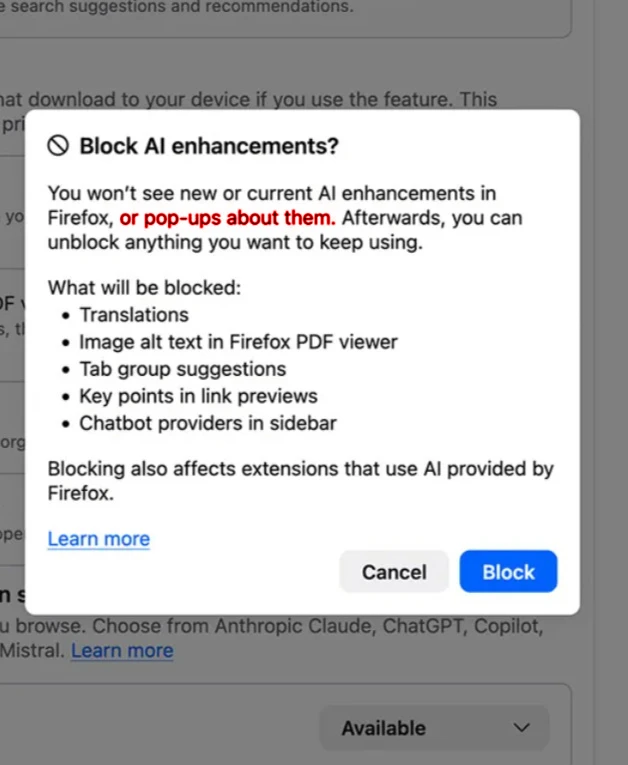
Said pop-up is explicitly mentioned on their “confirmation dialog” upon turning off (screenshot attached below):
You won’t see new or current AI enhancements in Firefox, or pop-ups about them.
It speaks volumes about how much a dark pattern this is, the fact that the opt-off has a confirmation dialog, while the further proceeding with logging in with Anthropic/OpenAI/Google/Meta account doesn’t seem to have a confirmation dialog.
And the fact that the confirmation feels “menacing” and defaulted to cancelling the opting-off (i.e. pressing “esc” or clicking outside the window; one must click the primary-colored “block” button which, contrasted to a grayish “Cancel” button, may psychologically induce the user into thinking “block” is a dangerous action), quite similar to the
about:configwarning screen.Ah, and the clanker options: notice the lack of alternative options for those who want a custom clanker, such as DeepSeek, Qwen, Z AI, Brazilian Maritaca IA and Amazônia IA (to mention some non-Chinese LLMs), or even something running locally through ollama. Seemingly no option for using a custom, possibly self-hosted LLM endpoint. The fact that all the options offered are all heavily corporate options (with Mistral being the “least corporate” of them all, but still Global Northern nonetheless) might tell us something…
All of these dark patterns, among others not mentioned, are the object of my critique, not just the fact that Mozilla is shoving clankers unto Firefox.
Whenever a feature needs an invasive pop-up and the opt-out brings up a second pop-up that requires further confirmation (but none seems to be offered upon actually using said feature), it is called a dark pattern, no matter if said feature requires further configuration.
PS, I don’t like this AI move of FF, I actually uninstalled it after years and years because of that.
It would have been a dark pattern if, just as an example, the “block” button was set as secondary action (in white) and the primary blue action was “cancel”.
A modal in general is not defined as a dark pattern (not sure why you say that).
And in this case a modal is used to manage a user journey “subtask”, which is a request to confirm a potential disruptive action: users may use firerox AI features for long, before deciding to turn them off, deeply changing their experience with the product.
I agree that it could have been done as a full page, but it is fine also as a modal on desktop (not mobile viewport)
And the fact that the confirmation feels “menacing” and defaulted to cancelling the opting-off (i.e. pressing “esc” or clicking outside the window; one must click the primary-colored “block” button which, contrasted to a grayish “Cancel” button, may psychologically induce the user into thinking “block” is a dangerous action), quite similar to the about:config warning screen.
I don’t think it’s menacing at all. It gives an informative list of features, which is nice to know. I could see a lot of people wanting to turn off all AI then realizing they actually want local translate instead of sending everything to google.
And you’ve got the button intents mixed up. Primary color is always the encouraged action in that kind of design. Dark pattern would be if the colors were flipped.
@Feyd@programming.dev @technology@lemmy.world
When we develop a system (I used to work as a DevOps for almost 10 years), the technical aspects aren’t the only aspects being accounted for: especially when it comes to the front-end (i.e. the UI the user sees, the UX how user interaction will happen and how it may be perceived by them), psychology (especially behaviorism) is sine qua non.
Shapes and colors often carry archetypal meanings: a red element feels “dangerous”, a window with a yellow triangle icon feels to be “warning” about something, a green button feels “okayish”. I mean, those are the exact same principles behind traffic lights.
And signs and symbols, ruling the world, don’t exist in a vacuum: a colored button besides a monochromatic button may, psychologically, lead to a feeling that the colored button is the proper way to proceed.
But… there’s a twist: imagine you have a light-gray “Cancel” and a colored (regardless of the color) “Block”. “Block” is a strong word. The length of the label text also does impart psychological effects. The human brain may see: “huh, I have this button which reads ‘block’ and it’s quite strong, and this other button which reads ‘cancel’ and it’s more easy to the eyes, maybe ‘block’ is dangerous”. Contrast matters: the comparison between a substrate and the substances is pretty much how we’re wired to navigate this world as living beings.
Now, corporations such as Apple (Safari), Google (Chromium), and very likely Mozilla (Firefox) as well, they have entire hordes of psychologists directly working for them, likely the same psychologists who’ll work together with their HR departments for evaluating the candidates who applied for a job position there. These psychologists, and/or psychoanalysts, they know about Jungian archetypes, they know about fight-or-flight response and other facets of our deeply-ingrained instincts, they know about how colors are generally perceived by the human brain. Those psychologists likely played a role when a brand was chosen, or when an advertisement pitch was made. They know what they’re doing.
UX/UI decisions are far from random choices from the leading team of project management engineers, it involved designers with psychologists. Again: they know what they’re doing, they know it pretty well. They know how the users are likely to keep the functionality. They know how the users, as Ulrich said, are very unlikely to touch the settings, likely to keep the defaults, no matter what those defaults are. Because they know humans are driven by the “least-effort” instinct, which is quite of a fundamental principle shared among living beings as a byproduct of the “lowest energetic point” (thermodynamic equilibrium) principle.
To me, a former full-stack developer, the newer Firefox interfaces don’t feel like Firefox is being psychologically fair and honest with the user’s mind. Dark patterns are often subtle, and they’re part of a purposeful, corporate decision.
What a load of horse shit. You don’t have any clue what you’re talking about and it shows.
The Translation feature seems to be classified under AI. Idk what technology does it actually use, but it’s done locally on device
They’re using something that technically is AI, but it was broadly never marketed as such, because it was built before “AI” became a marketing buzzword.