

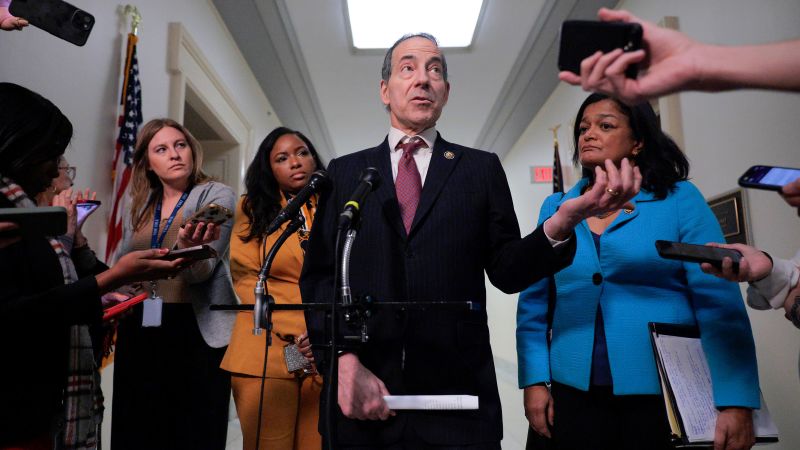
With two months until the midterm elections, Democrats are laying the groundwork to launch far-reaching investigations into the Trump administration and preparing for high-stakes court battles if they win control of the House of Representatives in November.
Donald Trump’s war with Iran, his White House ballroom project, his family’s business dealings and the administration’s handling of the Jeffrey Epstein files will be among the top targets of investigations if Democrats take back the House, according to conversations with over a dozen Democratic lawmakers and aides.
Democrats don’t want to squander the opportunity to act as a check on Trump if they reclaim the majority and say they have learned a lot since the last time the party controlled the House while Trump was in office. Few say they are interested in launching an impeachment process on day one, and many instead are eyeing a new tool that would be at their disposal to try to quickly compel the testimony and documents they seek: lawsuits.
Could someone explain how having a majority would impact the ability to sue people?
Aren’t the courts separate from the house of representatives?
Eta: Thanks all. I read the article again after the replies and noticed something I missed:
A different article explained the particulars:
As others noted the idea might be that if they are bringing suit about the office of the president ignoring congress, then if they sue as congress (by having the majority) it would be less likely to be challenged as not having standing.
Off topic but in the rest of the world we hear about how easy it is to sue in the states… but it seems it’s a lot easier for orgs to sue on behalf of others outside of the states!
Article III section 2 of the US Constitution.
Congress can say the President has done something illegal. The President can say they have not done anything illegal. You now have a controversy. The Constitution indicates that the judicial power will now handled it.
To sue someone or something means in the strictest of senses, “I wish to bring this matter before a court of law.” So a controversy has arisen, the courts have the right to review it. The Constitution outlines who is allowed to do what, and nobody is allowed to step out of that. So if a controversy wasn’t present, the the courts would have no jurisdiction.
Congress believes there is a controversy and thus they are suing. That means they wish to bring the controversy to the thing that’s indicated in the Constitution to settle such a thing.
However, you run into the very first question, “Is it a TRUE controversy? Or is it just a disagreement?” This is the no political questions doctrine. Congress and the President routinely disagree on things. The Courts aren’t there to settle a disagreement. It has to be a genuine controversy. That means “The law objectively says XYZ. The President specifically did not do XYZ. Ergo, this is not a disagreement but a President who is not following the letter of the law which is a controversy.”
So like anything Congress brings up, the President is allowed to say it’s not a controversy. What the ruling on that question, the President or Congress can appeal it. If the appeal isn’t good enough, the Supreme Court gets to make a final ruling. Once a controversy has been established, THEN, there’s the actual case. The the final decision of the case can be appealed and then brought before the Supreme Court.
Rarely do we actually get that far with things because you can’t get all that stuff done within a single President’s term. And the real reason a Controversy is attempted is to get discovery and things the President has been doing on the public record. Depends on what Congress is looking for. Perhaps they want to ensure Musk stays out of politics forever, a deep and heavy discovery process into him may just do that.
But Congress can bring a suit to the Courts so long as it’s within the powers of the Constitution for Congress to do so.
It is definitely all about the discovery.
Thanks for all this.
I understand what suing is (or at least I assume it’s not that far off from tort law)
What I don’t understand is why the democrats would have to have the majority in the house of representatives to sue. Does it have to be congress to sue? Doesn’t the blurb say citizens can sue? In this case does congress mean the senate or the house of representatives? Either or both?
As you’ve discovered, there’s another element before a court accepts a case. Standing.
To have standing, you must show that you have a personal and direct stake in the outcome. You cannot sue just because you are angry or disagree with a law. Courts only solve real, active disputes, not hypothetical questions.
Congress has to bring the suit. Courts have routinely held that in order for “Congress” to have standing in court, they must show that “Congress” has a direct stake in the outcome. To show they do so have such a stake, they routinely vote on a Resolution to establish that Congress as a body is bringing the case.
So while individual members might try to bring a case, it really depends on what’s to be litigated before the court. A President not following the law usually indicates that Congress who created the law, is the one who is to bring it. But if the President does something that affects specifically a single member, then that member by themselves would have standing.
Citizens can sue if they can show they were directly harmed and have a direct stake in some resolution to the harm.
As far as, the Senate or the House, it depends on the injury being talked about. A simple resolution from a single chamber is the most common when the injury is specific to that chamber. A joint or concurrent resolution (by both chambers) usually is to address a broad power violation. It really depends and it’s up to the Judge to uses what’s come before as a guide.
The House usually originates the spending, and so if that’s the topic, usually just the House is enough. If the President is abusing something like war powers, then that is indicated in the Constitution as “Congress” as in the entire thing. So both chambers might be needed to have standing, unless the issue at hand is that “The President has abused their war powers and not reported to the House Oversight Committee”. In that case, the argument is that the President isn’t reporting their abuse to a single chamber and thus only the House is required to have standing. Same if the Senate is conducting an investigation and the President refuses the subpoena. The injury is just to the Senate in that case.
It all depends on how the entire thing is brought before the court.
What would seem likely to me is that if the party making the charge is ‘the house’ as a separate entity then you would need a majority willing to vote to support such an action. As the authors of law they would have some authority to speak to the to the intent of it, thus standing.
I could be wrong, but I think the strategy is to take control of the House, then request documents and testimony, then when ignored issue subpoenas for documents and testimony, then when they’re not forthcoming with everything, sue. Then with that publicity focused on the administration having something to hide regarding the investigations into what seems to be illegal activity, bring out the articles of impeachment.
“We suspected impeachable offenses, but rather than immediately and perhaps rashly jumping straight to impeachment, we elected to do our due diligence and offer an opportunity for this President to address the facts of these matters. Instead of seizing that opportunity, he has ignored and attacked this body while hiding information from this coequal branch of government which exists to act as a check on the power of the President. We are left with no choice but to assume that he is in violation of his oath to the Constitution, acting on behalf of himself above all, and must be removed from power before any further irreversible harm is done to this nation, her citizens, and her allies. This is not an attack, this is not vengeance, this is not pettiness; this is an act of critical emergency to ensure the survival of this Republic. This is what is required of every elected member of Congress by our own oath to the Constitution.”
Thanks. Is there a reason they can’t bring lawsuits without the calling investigations via Congress? I read about orgs or states suing the gov. What am I missing that they can’t bring suits now? Maybe they aren’t the wrong party in a super black and white way?
Again, I could be wrong, but I think it’s not really “Congress” that is suing unless the majority is suing. If the issue is that the president is acting illegally, well the scotus already said that that’s allowed if the illegal acts are official acts by the office of the president, partially because impeachment is already an available avenue; then sue/indict once he’s no longer president.
Orgs can sue, but individuals can’t sue for stuff that is generally affecting all. For example, I as an individual can’t sue just because I disagree with spending tax dollars on helping Israel or hurting Iran, but Congress could sue if they explicitly did not authorize that spending and the administration did it anyway. But I don’t think any ole member could do that, I think it’s probably either from the speaker or voted on. I’m speculating, so somebody please correct me if you know better than my guesses.
For impeachment proceedings yes, but there are already impending issues, like the ballroom construction project or some immigration cases that the Supreme Court can say can keep going because the Trump administration has repeatedly argued that the existing claimants don’t have standing and only Congress can have a say. My thought is the House Majority Leader should be able to take a lot of the existing evidence to get injunctions to halt the most immediate harms while they collect more.