Sorry but this is a nonsense doom-mongering take. The Trans rights issue is a complex mess but it’s not the end of democracy. That is hyperbolic nonsense.
The UK Supreme Court ruling is a reflection of a huge problem facing all countries: how do you reconcile women’s right and trans rights? The Supreme Court ruled that in the UK Equality Act, the terms “Man”, “Woman” and “Sex” referred to biological sex at birth, not gender identity and that a Gender Recognition Certificate does not change a persons biological sex under the law.
This was a clarification of the law as it stands; this was the way the legislation had been written and it ensures the Equality Act is applied clearly. It is not anti-democratic; Parliament makes the law and the courts interpret how it is written and remove ambiguity.
As this article mentions: it is up to Parliament now to change the law if it wants to. Parliament IS sovereign and can amend the Equality Act or provide a new definition for gender/sex. But there is a brutal reality why it is not doing so: this is a hugely divisive issue particularly for the Labour party. Women’s rights and Transgender rights are in conflict, and it’s extremely difficult to reconcile that. We’ve already seen how this played out in Scotland for the SNP, and Labour are in the same position. It can be argued to be cowardly and weak of them not to try to resolve this issue, but it is not fundamentally undemocratic. Labour don’t want to discuss this because they want to focus on other issues that they see as helping them stay in power.
It’s a nonsense to say this is the “start of democratic collapse”. It’s correct that the Right-wing have moved against trans rights, but for the Left it’s a paralysis of inaction due to there not being a simple solution that can please both sides. Women’s rights activists fundamentally hold that biological sex is immutable as that underpins their rights; Trans rights activists fundamentally hold that gender is not immutable as that underpins their rights.
Other countries are or will go through similar issues. Other rights like gender equality, race equality, Gay rights etc were controversial but they did not as fundamentally bring two groups rights into conflict. Arguably Gay rights and rights of religious expression did come into conflict and remain in conflict, and that was a long drawn out process but eventually there was a form of consensus. That is constantly under attack in multiple countries, and the balance may shift again on issues like Gay marriage if the Right-wing have their way. But with Trans-rights we have not even reached a stable political consensus of any form - it remains hugely controversial on the Right and Left for different reasons.
People seem to look back at the various rights issues over the past century and see a pattern of inevitability of the “good” winning, and people gaining their rights. Instead it’s a story of constant fighting and battles by different groups to be heard, and for their rights to be established and recognised. That war is ongoing in all those areas whether that is gender, race, sexual orientation etc. For Trans rights, we’re still in the worst part of the fighting. As with other rights issues, it may ultimately be resolved to some extent as we have generational changes that society changes and the law changes. Just as Gen X and Millenials had to come to the fore before Gay rights were finally recognised and enshrined properly in law in most countries, it may well be that it won’t be until Gen Z and Gen Alpha come to the fore in politics that their own social and political views on this are reflected in the law. Gen Z and Gen Alpha seem to be much more comfortable with seeing gender as changeable and not immutable like biological sex - that will inform the way things go long term.
This is not a failure of democracy. This is democracy in action. It is slow, it is flawed, and it seldom makes everyone happy. But change does slowly happen and things do generally get better over time as we have seen across the last 100+ years. People who believe in Trans rights need to keep fighting, they need to keep drawing attention to the issues and their plight and they must be organised and influence those people standing in the next general election, and the one after that and so on. Change can be achieved but it is seldom easy. But at the same time, Women’s rights activists also need to be listened to and the fundamental concerns around encroachment on their rights have to be addressed. I can’t pretend to know what the final answer will be - it is hugely complex and controversial with reason on both sides.
There is a failure of democracy here, if both the current pm and the prospective new pm treat the supreme court result as something they have to “implement” democracy has failed.
They can (must!) set the law, yes its difficult for labour, but to be able to shrug it off as not their job and have the entire press nod along is a direct failure.
You dont even need to agree, or care, who is right to see this is a real democratic problem.
Women’s rights and Transgender rights are in conflict
Some of us would strongly disagree with this fundamental premise of yours. You state it like it’s a solid basis on which these matters should be debated, but it’s actually a controversial point that could only emerge as the conclusion of an argument. It needs justification at least.
The conception of an identity as a woman being rooted in sex and sex based rights being fought and won for by successive generations against a male dominated and sexist society is in conflict with the the conception of an identity as a woman not being rooted in sex but in ones idea of gender which could include people of the male sex.
The conception of an identity as a woman being rooted in sex and sex based rights being fought and won for by successive generations against a male dominated and sexist society
That’s the part that’s not universal. It’s how the issue is portrayed in the UK, but I’ve never seen it described as such in Germany, for example. “Womanhood” is experienced by those who are judged femme by society and women’s rights are related to gender, not sex. James Barry didn’t advance women’s rights the way that Elizabeth Anderson did, because even after the autopsy, the culture didn’t look at Barry and call him a woman.
I lived in Britain for over a decade, but I’m not from there and my personal references are from Northern and Southern Europe.
In simple terms, Britain is incredibly sexist (even compared to Southern Europe), but they practice what’s called “Benevolent Sexism” - “women are emotional sensitive creatures which must be protected”.
The “benevolence” here is the mask covering the denial of agency of women and of their capabilities (for example, this very argument is deployed to claim that due to their “sensitivity” women can’t handle the harsh environment of corporate top management) - women aren’t just treated as “less capable” than men, they’re expected to try to fit with the image, so you see a lot more and a lot thicker “performative masking” on at least English women (especially middle class and above) than you see in Northern or Southern Europe - women in Britain aren’t supposed to be emotionally strong individuals fully confident in themselves for being themselves and not caring about what other people think of them.
So yeah, from that discriminative take on women comes that idea (that also ends up in Law) that one has to “protect” women by treating them in a different way from the rest purely because of their gender (which is why “solutions” in Britain for sexism are invariably of the “treat women differently” kind), and on such an environment of sexist thinking and practice it’s pretty natural that the issue of “what makes a woman a woman” is taken to extremes and is framed as one of “protecting women”.
The hilarous bit is that, lacking references from having lived elsewhere with totally different cultural expectations on women, most Brits (including women) never EVER examine that axiom that “women are more fragile and thus must be protected” so genuinelly think that all these assumptions about women and the discriminatory behaviour “to protect them” is not sexism but the very opposite of it.
In such an context and under such an anti-egalitarian take on gender, transfobia anchored on “protect women” and even parroted by the local “Feminists” is very much a natural thing.
Okay, but there is a demographic in the UK who understands their identity that way and the law is apparently worded as such appealing to sex.
Thank you for bringing up James Barry, that’s very interesting.
Society being sexist and those being judged as femme being on the receiving end of that discrimination is something I agree with.
But this definition doesn’t account for someone who is female and understands herself to be a woman but didn’t conform to gender norms.
Is womenhood defined by sex, by how society sees you or by your own gender identity.
Maybe its all three in different circumstances and scenarios.
That people hold different values into how we should understand one and other in terms sex and gender isn’t necessarily a problem in a liberal society.
Its not the sole issue, but UK democracy is going askew. Tougher laws on protesting. Arresting citizens for free speech.
Arresting people for wearing shirts about the genocide in Palestine.


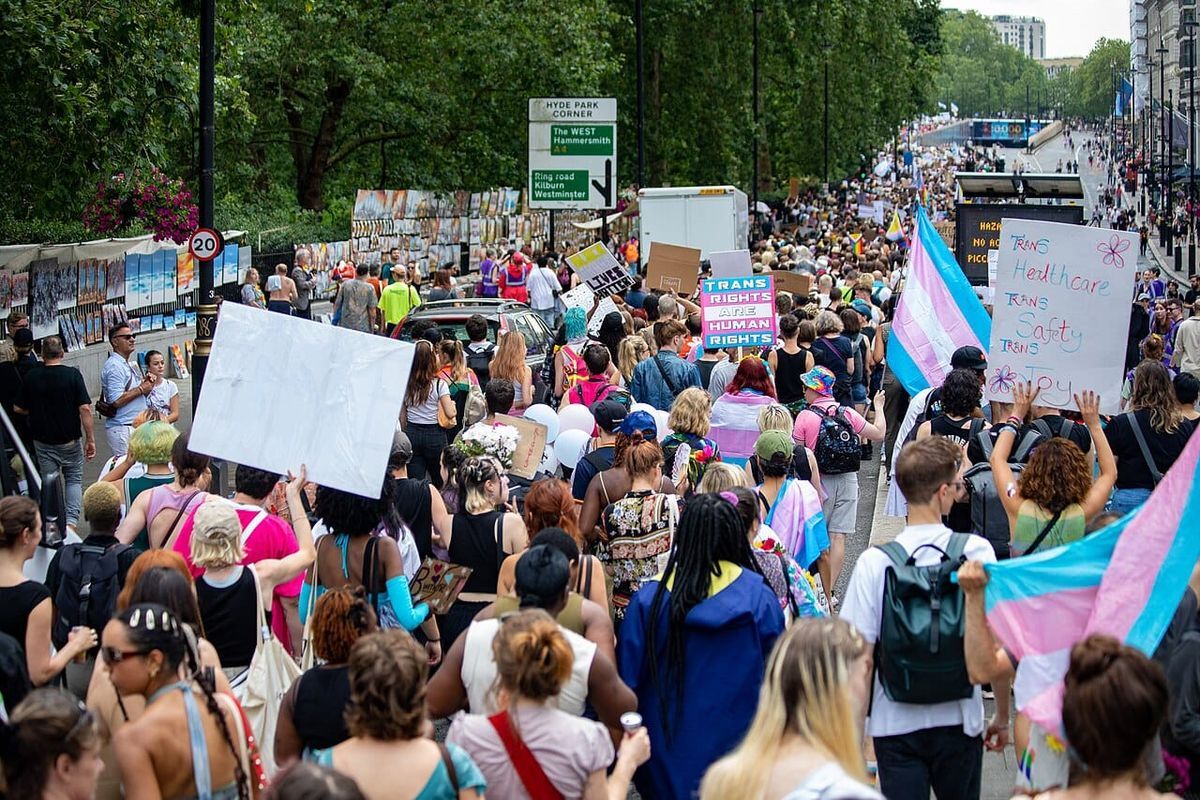
Sorry but this is a nonsense doom-mongering take. The Trans rights issue is a complex mess but it’s not the end of democracy. That is hyperbolic nonsense.
The UK Supreme Court ruling is a reflection of a huge problem facing all countries: how do you reconcile women’s right and trans rights? The Supreme Court ruled that in the UK Equality Act, the terms “Man”, “Woman” and “Sex” referred to biological sex at birth, not gender identity and that a Gender Recognition Certificate does not change a persons biological sex under the law.
This was a clarification of the law as it stands; this was the way the legislation had been written and it ensures the Equality Act is applied clearly. It is not anti-democratic; Parliament makes the law and the courts interpret how it is written and remove ambiguity.
As this article mentions: it is up to Parliament now to change the law if it wants to. Parliament IS sovereign and can amend the Equality Act or provide a new definition for gender/sex. But there is a brutal reality why it is not doing so: this is a hugely divisive issue particularly for the Labour party. Women’s rights and Transgender rights are in conflict, and it’s extremely difficult to reconcile that. We’ve already seen how this played out in Scotland for the SNP, and Labour are in the same position. It can be argued to be cowardly and weak of them not to try to resolve this issue, but it is not fundamentally undemocratic. Labour don’t want to discuss this because they want to focus on other issues that they see as helping them stay in power.
It’s a nonsense to say this is the “start of democratic collapse”. It’s correct that the Right-wing have moved against trans rights, but for the Left it’s a paralysis of inaction due to there not being a simple solution that can please both sides. Women’s rights activists fundamentally hold that biological sex is immutable as that underpins their rights; Trans rights activists fundamentally hold that gender is not immutable as that underpins their rights.
Other countries are or will go through similar issues. Other rights like gender equality, race equality, Gay rights etc were controversial but they did not as fundamentally bring two groups rights into conflict. Arguably Gay rights and rights of religious expression did come into conflict and remain in conflict, and that was a long drawn out process but eventually there was a form of consensus. That is constantly under attack in multiple countries, and the balance may shift again on issues like Gay marriage if the Right-wing have their way. But with Trans-rights we have not even reached a stable political consensus of any form - it remains hugely controversial on the Right and Left for different reasons.
People seem to look back at the various rights issues over the past century and see a pattern of inevitability of the “good” winning, and people gaining their rights. Instead it’s a story of constant fighting and battles by different groups to be heard, and for their rights to be established and recognised. That war is ongoing in all those areas whether that is gender, race, sexual orientation etc. For Trans rights, we’re still in the worst part of the fighting. As with other rights issues, it may ultimately be resolved to some extent as we have generational changes that society changes and the law changes. Just as Gen X and Millenials had to come to the fore before Gay rights were finally recognised and enshrined properly in law in most countries, it may well be that it won’t be until Gen Z and Gen Alpha come to the fore in politics that their own social and political views on this are reflected in the law. Gen Z and Gen Alpha seem to be much more comfortable with seeing gender as changeable and not immutable like biological sex - that will inform the way things go long term.
This is not a failure of democracy. This is democracy in action. It is slow, it is flawed, and it seldom makes everyone happy. But change does slowly happen and things do generally get better over time as we have seen across the last 100+ years. People who believe in Trans rights need to keep fighting, they need to keep drawing attention to the issues and their plight and they must be organised and influence those people standing in the next general election, and the one after that and so on. Change can be achieved but it is seldom easy. But at the same time, Women’s rights activists also need to be listened to and the fundamental concerns around encroachment on their rights have to be addressed. I can’t pretend to know what the final answer will be - it is hugely complex and controversial with reason on both sides.
eat shit transphobe
tl;dr
Yeah, I’m not reading all of that. Suck my girl dick
There is a failure of democracy here, if both the current pm and the prospective new pm treat the supreme court result as something they have to “implement” democracy has failed.
They can (must!) set the law, yes its difficult for labour, but to be able to shrug it off as not their job and have the entire press nod along is a direct failure.
You dont even need to agree, or care, who is right to see this is a real democratic problem.
Some of us would strongly disagree with this fundamental premise of yours. You state it like it’s a solid basis on which these matters should be debated, but it’s actually a controversial point that could only emerge as the conclusion of an argument. It needs justification at least.
What do you think the current conflict is about ?
Knuckledraggers who would rather exterminate a whole class of people than be dragged into the 21st century
That, and it’s a convenient wedge issue meant to distract people from the class war that is happening
The conception of an identity as a woman being rooted in sex and sex based rights being fought and won for by successive generations against a male dominated and sexist society is in conflict with the the conception of an identity as a woman not being rooted in sex but in ones idea of gender which could include people of the male sex.
That’s the part that’s not universal. It’s how the issue is portrayed in the UK, but I’ve never seen it described as such in Germany, for example. “Womanhood” is experienced by those who are judged femme by society and women’s rights are related to gender, not sex. James Barry didn’t advance women’s rights the way that Elizabeth Anderson did, because even after the autopsy, the culture didn’t look at Barry and call him a woman.
I lived in Britain for over a decade, but I’m not from there and my personal references are from Northern and Southern Europe.
In simple terms, Britain is incredibly sexist (even compared to Southern Europe), but they practice what’s called “Benevolent Sexism” - “women are emotional sensitive creatures which must be protected”.
The “benevolence” here is the mask covering the denial of agency of women and of their capabilities (for example, this very argument is deployed to claim that due to their “sensitivity” women can’t handle the harsh environment of corporate top management) - women aren’t just treated as “less capable” than men, they’re expected to try to fit with the image, so you see a lot more and a lot thicker “performative masking” on at least English women (especially middle class and above) than you see in Northern or Southern Europe - women in Britain aren’t supposed to be emotionally strong individuals fully confident in themselves for being themselves and not caring about what other people think of them.
So yeah, from that discriminative take on women comes that idea (that also ends up in Law) that one has to “protect” women by treating them in a different way from the rest purely because of their gender (which is why “solutions” in Britain for sexism are invariably of the “treat women differently” kind), and on such an environment of sexist thinking and practice it’s pretty natural that the issue of “what makes a woman a woman” is taken to extremes and is framed as one of “protecting women”.
The hilarous bit is that, lacking references from having lived elsewhere with totally different cultural expectations on women, most Brits (including women) never EVER examine that axiom that “women are more fragile and thus must be protected” so genuinelly think that all these assumptions about women and the discriminatory behaviour “to protect them” is not sexism but the very opposite of it.
In such an context and under such an anti-egalitarian take on gender, transfobia anchored on “protect women” and even parroted by the local “Feminists” is very much a natural thing.
Okay, but there is a demographic in the UK who understands their identity that way and the law is apparently worded as such appealing to sex.
Thank you for bringing up James Barry, that’s very interesting.
Society being sexist and those being judged as femme being on the receiving end of that discrimination is something I agree with.
But this definition doesn’t account for someone who is female and understands herself to be a woman but didn’t conform to gender norms.
Is womenhood defined by sex, by how society sees you or by your own gender identity.
Maybe its all three in different circumstances and scenarios.
That people hold different values into how we should understand one and other in terms sex and gender isn’t necessarily a problem in a liberal society.
Dw about the downvotes. Worldnews is botted.
Its not the sole issue, but UK democracy is going askew. Tougher laws on protesting. Arresting citizens for free speech. Arresting people for wearing shirts about the genocide in Palestine.