

If you are to believe the glossy marketing campaigns about ‘quantum computing’, then we are on the cusp of a computing revolution, yet back in the real world things look a lot less dire. At least if you’re worried about quantum computers (QCs) breaking every single conventional encryption algorithm in use today, because at this point they cannot even factor 21 yet without cheating.
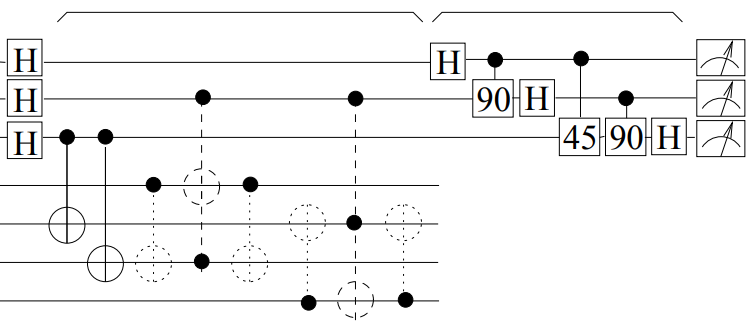
In the article by [Craig Gidney] the basic problem is explained, which comes down to simple exponentials. Specifically the number of quantum gates required to perform factoring increases exponentially, allowing QCs to factor 15 in 2001 with a total of 21 two-qubit entangling gates. Extrapolating from the used circuit, factoring 21 would require 2,405 gates, or 115 times more.
underlying article: https://algassert.com/post/2500
I mean, AI is what took the focus away from QC, especially after AlphaFold. Quantum Computing is potentially a society changing technology, now regarding practice we are really far away. The main expectations are in the field of medicine. I work in that field and I reckon that if the expectations placed on quantum computers were to come true, we’d be able to study the human body much quicker than now and to develop drugs much quicker than now. However, I do work nearby a Quantum computing centre and I have met quite a few persons who work in the field, both as researchers and entrepreneurs. Currently no computer can be used to make any real calculations and it is actually unclear if the molecular simulations are actually possible with a quantum computer. As far as I understand it, it may not be possible to encode the whole system in a quantum computer before it loses coherence. This may be an intrinsic limitation as for real problems you’d need to encode tens of thousands of electrons.